 English
 Español
 Português
Adicionar: nº6 Av. Longjin, Zona Industrial de Impressão de Jinxia, Município de Jinxiang, Condado de Cangnan, Cidade de Wenzhou, Província de Zhejiang
Tel: +86-19706000801

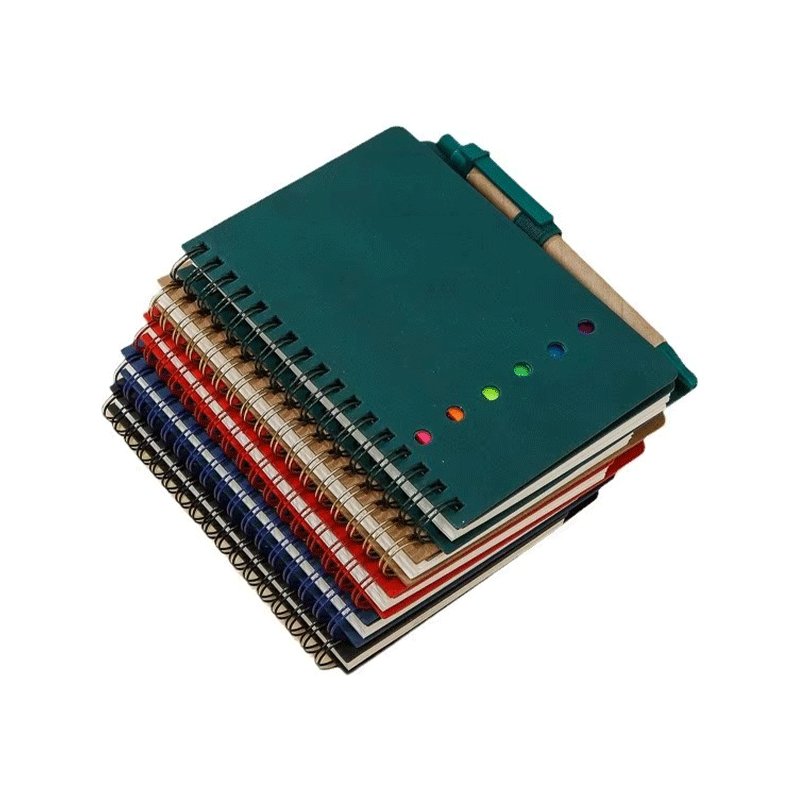
A notebook that will not lie flat is a notebook that fights the writer. The pages spring back. The hand holds the page down instead of writing. A coil notebook fixes this with a continuous spiral of wire or plastic threaded through holes along one edge. The pages turn freely. The notebook opens completely flat on the desk. It folds back on itself to take up half the space. For students, professionals, and anyone who writes by hand, the coil binding is the difference between a notebook that works and one that gets abandoned.
The coil is a single continuous spiral. It runs through holes punched along the edge of the pages and the cover. The coil can be steel wire with a coated finish or plastic. A coil notebook with a metal coil feels more durable. A plastic coil is lighter and never rusts.
The coil diameter matches the page count. Too small and the pages bind against the coil when they turn. Too large and the notebook feels loose and floppy. A coil notebook with the right coil diameter turns smoothly and holds the pages securely.
The ends of the coil are crimped or bent so the spiral does not slide out. A coil notebook with properly finished ends does not snag on the bag or scratch the desk.
The cover protects the pages. A poly cover is waterproof and flexible. A cardboard cover is stiffer and takes printing well. A coil notebook with a clear poly front cover and a black poly back cover protects the pages while showing whatever is printed on the first page underneath.
The pages inside carry the writing. Paper weight from 70 to 100 gsm handles ballpoint, gel, and rollerball. A coil notebook with paper that bleeds through loses half its pages to ghosting.
The ruling is lined, grid, dotted, or blank. A coil notebook offered in multiple ruling styles serves a broader market than a single-format product.
Many coil notebooks have perforated pages. The user tears out a page cleanly and leaves the coil intact. A coil notebook with properly perforated pages separates at the line without ripping into the next page.
The perforation also means the page comes out with the holes intact or cleanly removed depending on the design. A coil notebook with micro-perforation leaves a clean edge.
Here is what a coil notebook needs to deliver:
Students use coil notebooks for lecture notes. The notebook opens flat on the tiny lecture desk. The pages turn fast when the professor moves fast. A coil notebook handles the pace.
Professionals use coil notebooks for meeting notes and project logs. The notebook folds back to fit on a clipboard or a crowded desk. A coil notebook that folds completely in half saves space.
Home users keep a coil notebook in the kitchen or by the phone. The spiral binding stands up to the humidity and the rough handling better than a glued binding.
The coil catches on clothing, on bag fabric, on other notebooks. A coil notebook with properly crimped ends catches less but still catches. That is the trade-off for the flat-open binding. The coil deforms when the notebook is crushed in a bag. A metal coil with proper temper springs back. A cheap coil stays bent. The pages tear out because the punched holes were too close to the edge. Proper hole placement prevents the tear.
A coil notebook is a tool for writing. The binding opens flat. The pages turn easy. The cover protects. Choose a notebook with the right coil, paper that holds ink, and perforations that tear clean. The writing will happen and the pages will stay together. That is the point.
Direitos autorais © Wenzhou Yinliang Stationery Co., Ltd.
